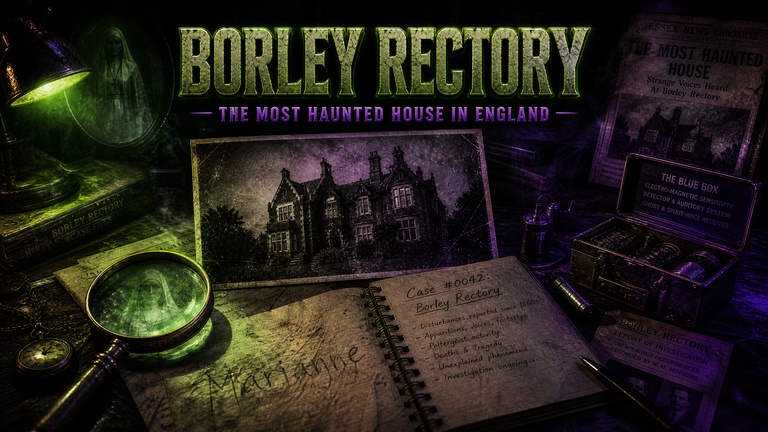
A House With a Legend Attached
Borley Rectory was built in 1862 by the Reverend Henry Dawson Ellis Bull, replacing an earlier rectory on the same site that had itself burned down in 1841. Local legend attached itself to the location almost immediately: tales of a Benedictine monk who fell for a nun from a nearby convent, was executed for it, and left the nun to be bricked up alive within the convent walls as punishment. A second, later legend told of a French nun, murdered and buried beneath the site by a jealous member of the Waldegrave family. Neither story has ever been substantiated by historical record, and claims that a monastery or nunnery ever stood on the site have been specifically discredited.
Reports of strange happenings — unexplained footsteps, a phantom coach and horses driven by a headless coachman — circulated around the rectory for decades under the Bull family’s long occupancy. But the case that made Borley famous began in 1928, when new occupants Reverend Guy Eric Smith and his wife, unsettled by what they were experiencing, contacted the Daily Mirror for help finding a psychical researcher. The paper sent Harry Price.
Enter Harry Price
Price was already one of the best-known psychic researchers in Britain, and controversial for it — an expert at exposing fraudulent mediums who had, according to critics, no formal scientific training of his own. His first visit to Borley in June 1929 produced immediate results: reported poltergeist activity, including a stone thrown at a visiting reporter that allegedly struck him, though the same reporter later found similar stones in Price’s own pockets — an incident critics have long pointed to as an early sign of how the case’s evidence was generated.
The Reverend Lionel Foyster and his wife Marianne took over the rectory in 1930, and the phenomena, according to reports collected at the time, intensified dramatically: messages scrawled on the walls apparently addressed to Marianne, objects moving and thrown, bells ringing unprompted. The Foysters left in 1935. In 1937, after the rectory stood empty, Price took out a year’s lease on the building himself and recruited a rotating team of volunteer investigators to keep watch, interview witnesses, and run experiments — the effort that produced most of the material for his books and cemented Borley’s reputation.
Among the material Price gathered were séance sessions, run by team member Roger Glanville’s daughter Helen, in which a spirit claiming to be a French nun named Marie Lairre said she had been murdered and buried at the site — a claim that fed directly into the second nun legend, in a case of investigation and folklore reinforcing each other.
Fire, Excavation, and Demolition
Price’s lease ended in 1938 and the rectory was sold to Captain W. H. Gregson, who renamed it “The Priory” and had little patience for the ghost stories. On the night of 27 February 1939, an oil lamp was knocked over — Gregson said books had flown from a shelf and struck it — and the resulting fire gutted much of the building. Price later noted, with evident relish, that a spirit contacted during the 1937–38 séances had predicted the rectory would burn in 1938; the fire arrived roughly a year late.
The ruin remained standing for several more years and continued to draw investigators. Price organised an excavation of the cellars in 1943, during which bones were discovered and given a Christian burial — taken by some as confirmation of the Marie Lairre story, though the bones were never reliably dated or identified. The rectory was finally demolished in 1944.
The Case Against the Case
Price died in 1948. Rather than settling the matter, his death opened it up. In 1956, three researchers connected to the Society for Psychical Research — Eric Dingwall, Kathleen Goldney, and Trevor Hall — published The Haunting of Borley Rectory, a detailed reassessment that concluded the great majority of the phenomena Price had reported were either exaggerated, misattributed to mundane causes such as rodents and structural settling, or in some cases fabricated by Price himself to sustain the story. The SPR’s own formal study reached similar conclusions, and Price’s reputation as a researcher has never fully recovered from it.
The most damaging testimony came from within the case itself. Marianne Foyster, whose years at the rectory produced some of its most dramatic reported phenomena, later stated in life that she had never experienced anything genuinely supernatural in the house, and that the wall-writing and other incidents attributed to a haunting were not what they had been presented as.
Not every investigator connected to Borley shared this verdict. Peter Underwood, who joined the case as a young man at Price’s invitation and later spent decades tracking down and interviewing nearly everyone still living who had a connection to the rectory, took a more measured position: publishing his own account, The Ghosts of Borley, in 1973, while maintaining across his long career that the great majority of reported hauntings had mundane explanations and only a small minority of cases — Borley among the candidates — genuinely resisted one.
Assessment
Borley’s evidentiary problems are severe and well documented. The 1956 SPR-connected reassessment identified specific, plausible mundane sources for a large share of the reported phenomena, Marianne Foyster’s later admission undercuts one of the case’s central witness sources, and Price’s own record of self-promotion and at least one documented incident of planted evidence make him an unreliable narrator of his own investigation. On the strength of the published critique, Borley is now generally treated by historians of the paranormal as a cautionary tale about investigator bias rather than a genuine haunting.
What keeps the case from being fully closed, for those who still find it compelling, is the sheer volume and independence of witness testimony spanning decades and several unconnected households — the Bulls, the Smiths, the Foysters, outside visitors, and later witnesses at Borley Church itself, after the rectory’s ruins were cleared — combined with the fact that no single explanation accounts for every reported incident across that span. Whether that reflects a genuine unexplained residue or simply the ordinary accumulation of rumour, suggestion, and coincidence around a house already primed by legend before Price ever arrived is a question the case has never definitively answered either way.
Sources: Psi Encyclopedia (Society for Psychical Research), “Borley Rectory”; Harry Price, The Most Haunted House in England (1940) and The End of Borley Rectory (1946); Eric Dingwall, Kathleen Goldney & Trevor Hall, The Haunting of Borley Rectory (1956); Peter Underwood, The Ghosts of Borley (1973); harrypricewebsite.co.uk.