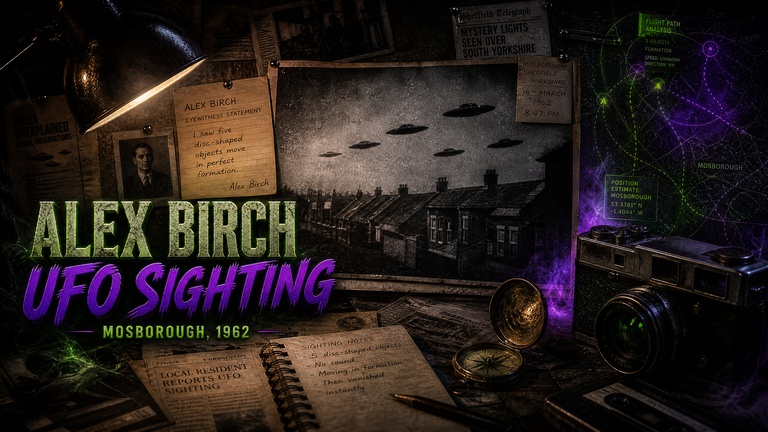
The 1962 Photograph
Birch’s photograph joined a small, notorious set of British “classic saucer” images taken by teenagers in the 1950s and ’60s, alongside Stephen Darbishire’s 1954 Lake District photo, Gordon Faulkner’s 1965 shot of the Warminster “Thing,” and Stephen Pratt’s 1966 image over a chip shop in Conisbrough. All four have been argued over for decades; none has been conclusively proven or disproven.
Birch and his father were called in to the Air Ministry, where officials examined the camera and the print. The Ministry’s public conclusion — that the shapes were sunlight reflecting off ice crystals in smoky air — satisfied almost no one, including ufologists who felt it was a face-saving dodge rather than a genuine explanation.
The 1972 Confession — and the Reversal
For a decade, Birch lived with the consequences of sudden, unwanted fame. He has said he was mocked at school and struggled to be seen as anything other than “the lad who photographed flying saucers.” In 1972, aged 24, he went to the Daily Express and stated the photograph was a hoax, reportedly appearing on television with a pane of glass on which he said the “saucers” had been painted.
The confession did what he intended: public interest faded and he was able to get on with his life. But it did not end the story. In 1998, Birch reversed course again, stepping back into the spotlight to reclaim copyright over the image and to insist that the 1972 confession was itself the lie — that he really had seen and photographed something over Sheffield in 1962.
This reversal is the detail that keeps the case unresolved for researchers rather than closed. Journalist and Fortean researcher Dr David Clarke, who studied the case at length with fellow researcher Andy Roberts, has written that no one has ever been able to demonstrate exactly how the original photograph might have been faked, even after Birch’s own claim that it was.
The Second Photograph: Retford, 2004
On the evening of 27 January 2004, now a grandfather living in Nottinghamshire, Birch drove out into heavy snowfall to photograph Retford town square for a local photography competition. He didn’t notice anything unusual while shooting. When the slide film came back from processing, one frame showed what looked like a disc-shaped object beside the town hall — its clock fixing the time at 23:08.
Unlike in 1962, Birch avoided publicity and instead pursued technical analysis. Sheffield University’s Department of Physics and Astronomy ruled out astronomical explanations, and local airfields confirmed no aircraft were in the area. Kodak’s laboratory in Lincoln examined the slide and reported finding no evidence of double exposure, lens flare, retouching, or drying stains, noting that the anomalous shape shared the same grain, density, and colour characteristics as the rest of the frame. A technician there wrote directly on the photograph that it had not been altered.
Birch also approached the Ministry of Defence, which he had first dealt with as a schoolboy in 1962. A copy of the slide was passed to the MoD’s Defence Geographic and Imagery Intelligence Agency for analysis. Their report, completed in August 2004, reached no firm conclusion, though it raised the possibility — without confirming it — that the object’s illuminated edge passing through the centre of the frame might indicate a lens anomaly, such as a droplet of moisture on the lens.
Wider Claims
Beyond the two photographs, Birch has described a broader pattern of experiences across his life: poltergeist activity, unexplained electromagnetic and audio phenomena, being struck by lightning, and — regarding the 2004 photograph specifically — flashbacks to the night in Retford involving a much larger craft than the one visible on film, along with a suspected period of missing time. He has said family members have witnessed some of these phenomena independently. In a later documentary, he also made more extraordinary claims dating to the 1962 furore, including meetings with members of the British royal family and a telephone conversation with President John F. Kennedy.
None of these ancillary claims have independent corroboration beyond the testimony of Birch and people close to him.
Assessment
The Birch case resists a tidy verdict, and that is precisely what has kept researchers returning to it. Clarke and Roberts, writing in Fortean Times after a decade of contact with Birch and his family, described finding them “completely normal, open and honest” while remaining unable to reach a conclusion — noting that a retracted hoax confession does not, by itself, prove the original photograph was faked, and that expert analysis of the second photograph, while inconclusive, did not identify a definite mundane cause either.
Sceptical readings point to the obvious problems: a self-confessed hoax on record for the first photograph, however later disowned; a witness who did not see the object at the moment of exposure in 2004, which is consistent with common camera and lens artefacts such as lens flare or a droplet on the lens; and a widening set of paranormal claims — poltergeists, missing time, royal and presidential contacts — that extend well beyond what any physical evidence supports.
Those inclined to take the case seriously point to the technical difficulty of convincingly faking a photograph with 1962 equipment under Air Ministry scrutiny, the Kodak and university analysis finding no conventional explanation for the 2004 image, and the sheer improbability — Fortean or otherwise — of the same person capturing two contested aerial photographs, forty-two years apart, that neither side has ever been able to fully explain.
Sources: Andy Roberts & David Clarke, “Alex Birch UFO photos,” originally published in Fortean Times 235 (May 2008), reproduced at drdavidclarke.co.uk; David Clarke, The UFO Files; BBC News coverage of the National Archives MoD UFO file releases; drdavidclarke.co.uk, “New claims in film by the ‘lad who photographed flying saucers'” (2022).